 Backgammon Cat
Play now
Backgammon strategy for beginners
You don't need to memorise much to start winning more games. Learn these opening moves and a few simple ideas, and you'll play better straight away.
The best opening moves
Your first roll is never a double, so there are only 15 possible opening rolls. The moves below are popular, strong choices for each one. Some rolls have other good options too.
Moves are written as from/to, using your own point numbers, so 13/8 moves a checker from your 13-point to your 8-point.
| Roll | Move | The idea |
|---|---|---|
| 2-1 | 24/23, 13/11 | Split the back checkers and bring a builder down. |
| 3-1 | 8/5, 6/5 | Makes your 5-point. The best opening roll. |
| 4-1 | 24/23, 13/9 | Split and bring a builder down. |
| 5-1 | 24/23, 13/8 | Split and bring a checker to safety. |
| 6-1 | 13/7, 8/7 | Makes your bar point, starting a block. |
| 3-2 | 24/21, 13/11 | Move up a back checker and bring a builder down. |
| 4-2 | 8/4, 6/4 | Makes your 4-point. |
| 5-2 | 13/8, 13/11 | Bring two checkers down from the midpoint. |
| 6-2 | 24/18, 13/11 | Move a back checker up to the bar point. |
| 4-3 | 13/10, 13/9 | Bring down two builders. |
| 5-3 | 8/3, 6/3 | Makes your 3-point. |
| 6-3 | 24/18, 13/10 | Move a back checker up and bring a builder down. |
| 5-4 | 24/20, 13/8 | Step up to your opponent's 5-point and bring a checker to safety. |
| 6-4 | 24/14 | Run one back checker to the outfield. |
| 6-5 | 24/13 | Run one back checker all the way to safety. |
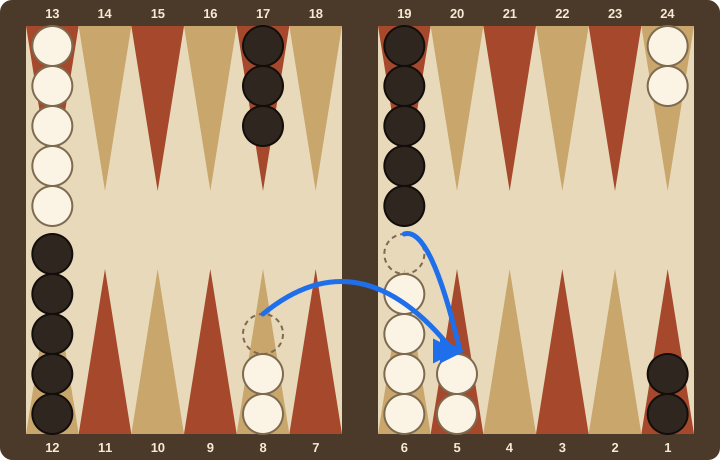
Make points, especially your 5-point
Two or more of your checkers on a point block your opponent and can't be hit. The points in and just outside your home board matter most, and your 5-point is the most valuable of all.
Be careful with blots
A lone checker can be hit, but not every blot is a mistake. Early in the game, when your opponent's home board is still weak, being hit usually costs less, and taking a small risk can help you build points later. Late in the game, or when your opponent has a strong home board, play it safe.
Build a prime
A prime is a row of points in a line. Six in a row can't be jumped at all, so any checker trapped behind it has to wait. Even a row of four or five makes life hard for your opponent.
Know when to race
Add up how many pips each player needs to get home. If you are ahead, try to get past your opponent's checkers and race. If you are behind, keep an anchor, which is a point in your opponent's home board, and wait for a shot.
When to double
As a simple guide for single games: double when you are a clear favourite and the game could soon turn into a win too big for your opponent to take. If you are offered a double, you can usually take it if you expect to win at least about one game in four.
Practise with hints
Play a game and tap Hint when you aren't sure. Backgammon Cat draws the best play on the board and shows your chance of winning as it changes, so you can see what each move does. Read more about playing against the AI.